
Azerbaijan
National Flag of Azerbaijan
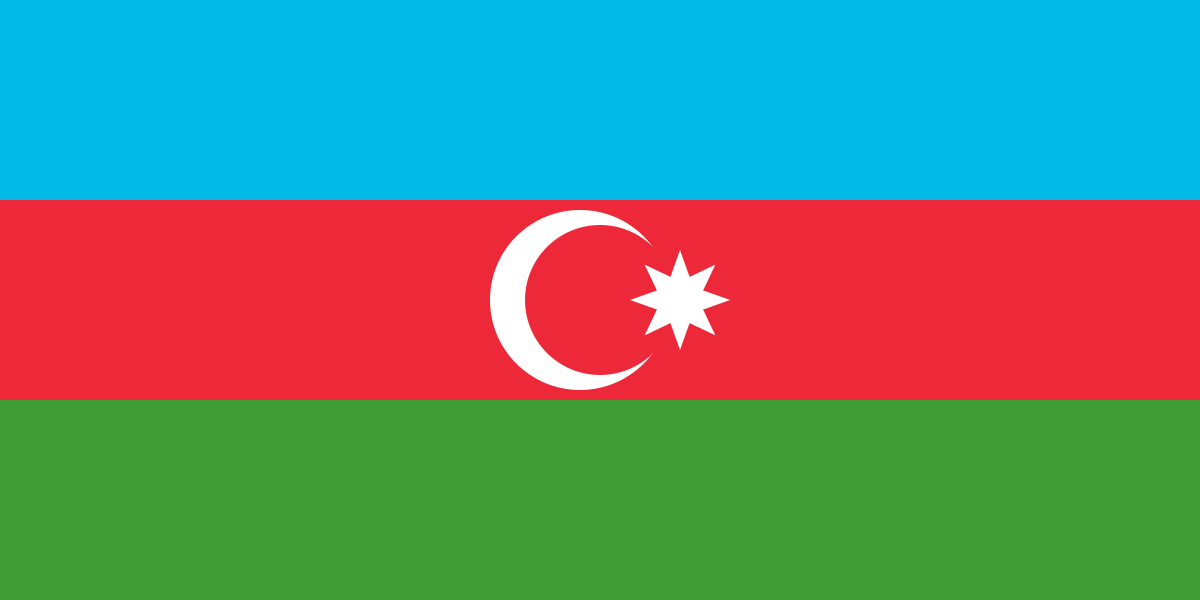
🇦🇿 Country Profile: Azerbaijan
🌍 Introduction
Azerbaijan is a transcontinental country located at the crossroads of Eastern Europe and Western Asia in the South Caucasus region, known for its diverse landscapes, energy resources, and rich cultural heritage. Positioned along the Caspian Sea, it connects inland Caucasus highlands with coastal lowlands. Historically influenced by Persian, Turkic, and Russian civilizations, the country reflects a blend of cultural and geographic characteristics.
📌 General Overview
Official Name: Republic of Azerbaijan.
Capital: Baku.
Official Language: Azerbaijani.
Government Type: Unitary presidential republic.
Currency: Azerbaijani Manat (AZN).
Time Zone: Azerbaijan Time (AZT).
🗺️ Country-Specific Maps
Political maps show national borders, districts, and major cities. Administrative maps present economic regions and districts. Physical and topographic maps highlight the Greater and Lesser Caucasus mountains, lowlands, and the Caspian coastline. Transportation maps display highways, railways, ports, and energy corridors. Thematic maps include oil and gas fields, land cover, and climate zones for spatial analysis.
👥 Demography & Population
Azerbaijan has an estimated population of about 10 million people. Major cities include Baku, Ganja, Sumqayit, and Mingachevir. A large share of the population lives in urban areas, especially around the Absheron Peninsula. The majority ethnic group is Azerbaijani, with several minority communities. Population distribution is influenced by lowland plains and major economic centers.
🏛️ Administrative Divisions
Azerbaijan is divided into districts and cities of national significance, grouped into larger economic regions. The capital city, Baku, has a special administrative status. Districts are further divided into municipalities that manage local governance and services.
💰 Economy & Industries
The economy is strongly supported by the oil and gas sector, along with petrochemicals and energy exports. Other important sectors include construction, transportation, agriculture, and services. Agricultural activities include grain, cotton, fruit, and livestock production. Trade and pipeline transit routes play a significant role in regional economic connectivity.
🌟 Places of Interest & Tourism
Notable places include the historic Inner City of Baku, the Flame Towers skyline, Gobustan rock art sites, mud volcano areas, and mountain villages in the Caucasus region. The Caspian Sea coast and cultural heritage sites attract visitors interested in history, architecture, and natural features.
🚆 Transportation & Connectivity
Transportation infrastructure includes national highways, rail corridors, seaports on the Caspian Sea, and international airports led by Baku. The country serves as a regional transit hub linking Central Asia and the Caucasus with Europe. Road and rail maps show major east–west and north–south corridors.
🌦️ Climate & Geography
Azerbaijan has varied climate zones ranging from semi-desert and dry steppe in lowlands to alpine conditions in mountain areas. The geography includes the Greater Caucasus in the north, the Lesser Caucasus in the west, and the Kura-Aras lowland in the center. The Caspian Sea coastline is a major geographic feature.
📜 History & Culture
Azerbaijan has a long history shaped by ancient kingdoms, regional empires, and Silk Road trade routes. Its culture blends Turkic, Persian, and Caucasian influences. Traditions in music, carpet weaving, poetry, and architecture are well known. Historic urban centers and archaeological landscapes reflect deep cultural continuity.
📌 Quick Facts & Trivia
Baku is one of the lowest-lying capital cities in the world by elevation. Azerbaijan is known for natural gas flames and mud volcanoes. Carpet weaving is a recognized traditional craft. The country sits along historic trade and energy corridors between regions. Tea culture and hospitality are important social traditions.