
Burkina Faso
National Flag of Burkina Faso
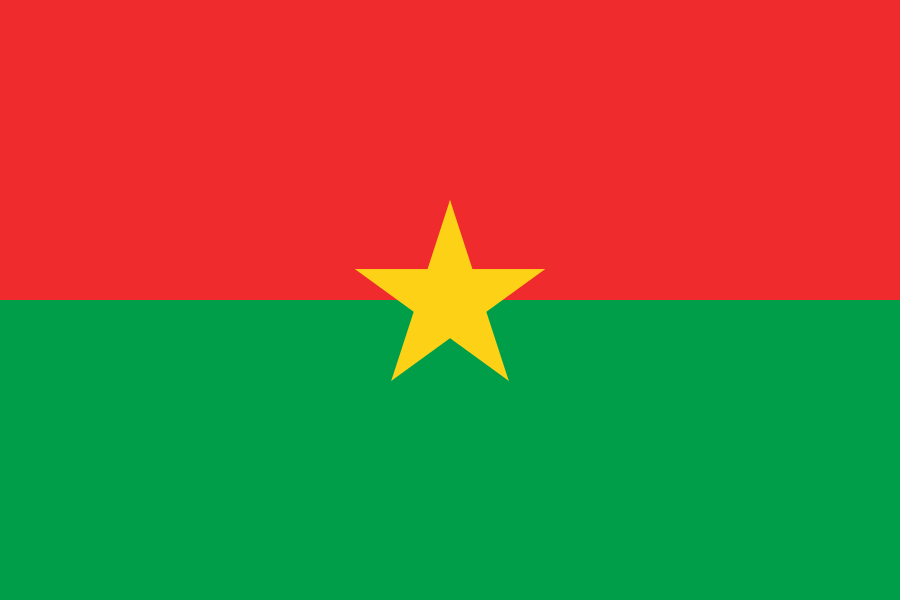
🇧🇫 Country Profile: Burkina Faso
🌍 Introduction
Burkina Faso is a landlocked West African country known for its savanna landscapes, cultural diversity, and strong artistic traditions. Located in the interior of West Africa, it connects Sahelian and savanna ecological zones. Its geography consists mainly of flat to gently rolling plains, seasonal rivers, and dry woodland areas.
📌 General Overview
Official Name: Burkina Faso.
Capital: Ouagadougou.
Official Language: French.
Government Type: Republic (under transitional authorities).
Currency: West African CFA Franc (XOF).
Time Zone: Greenwich Mean Time (GMT).
🗺️ Country-Specific Maps
Political maps show regional boundaries, major cities, and international borders. Administrative maps present regions, provinces, and departments. Physical maps highlight plateau surfaces, savanna zones, and river basins. Hydrology maps show seasonal rivers and reservoirs. Transportation maps display highways and cross-border corridors. Thematic maps often include land use, rainfall zones, and vegetation cover.
👥 Demography & Population
Burkina Faso has an estimated population of over 22 million people. Major cities include Ouagadougou and Bobo-Dioulasso. Population distribution is higher in central and southern regions where agriculture is more favorable. Many communities live in rural villages and farming areas. The country has numerous ethnic and language groups.
🏛️ Administrative Divisions
Burkina Faso is divided into regions, which are further subdivided into provinces and departments. Regional and provincial capitals serve as administrative and service centers. Local authorities manage community-level governance.
💰 Economy & Industries
The economy is supported by agriculture, mining, trade, and services. Key agricultural products include cotton, sorghum, millet, and maize. Gold mining is an important export sector. Small-scale trade and local manufacturing contribute to livelihoods.
🌟 Places of Interest & Tourism
Notable places include cultural heritage towns, traditional architecture sites, national parks, and craft centers. Historic mosques and cultural festivals are key attractions. Art and craft tourism is especially significant.
🚆 Transportation & Connectivity
Transportation is mainly road-based, with highway networks connecting major cities and border crossings. Rail service operates on limited corridors linking to neighboring countries. Airports serve the main urban centers. Road transport carries most passenger and freight traffic.
🌦️ Climate & Geography
Burkina Faso has a tropical savanna climate with a wet season and a long dry season. Rainfall decreases from south to north toward the Sahel. The terrain is mostly flat plateau with scattered hills. Seasonal water availability strongly affects agriculture.
📜 History & Culture
Burkina Faso has a history of regional kingdoms and long-standing cultural traditions. Cultural life is known for music, dance, crafts, and festivals. Wood carving, masks, and textiles are important artistic expressions.
📌 Quick Facts & Trivia
Burkina Faso lies within the West African savanna and Sahel transition zone. Cotton and gold are major exports. Many festivals celebrate music and arts. Traditional mask-making is internationally recognized. Most rivers are seasonal rather than permanent.