
Cabo Verde
National Flag of Cabo Verde
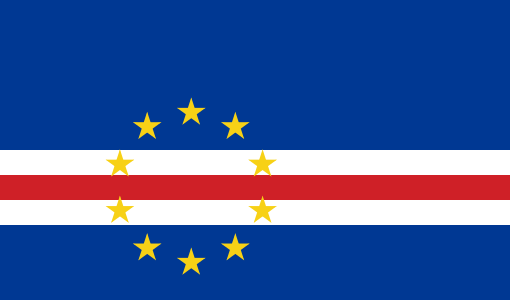
🇨🇻 Country Profile: Cabo Verde
🌍 Introduction
Cabo Verde is an Atlantic island country known for its volcanic islands, dry climates, and strong maritime culture. Located off the northwest coast of Africa, it consists of an archipelago of islands and islets spread across the ocean. Its geography includes volcanic peaks, rocky coastlines, sandy beaches, and arid uplands.
📌 General Overview
Official Name: Republic of Cabo Verde.
Capital: Praia.
Official Language: Portuguese.
Government Type: Parliamentary republic.
Currency: Cape Verdean Escudo (CVE).
Time Zone: Cape Verde Time (CVT).
🗺️ Country-Specific Maps
Political maps show the island groups and municipal boundaries. Administrative maps present municipalities across the inhabited islands. Physical maps highlight volcanic mountains, lava fields, and coastal plains. Marine maps show island spacing, sea routes, and fishing zones. Transportation maps display ports, airports, and inter-island connections. Thematic maps often include climate zones, land cover, and tourism areas.
👥 Demography & Population
Cabo Verde has an estimated population of about 600,000 people. Major population centers include Praia and Mindelo. Population is concentrated on a few main islands, while others are sparsely inhabited. Settlement patterns are shaped by water availability, ports, and services. Urban coastal towns are key population hubs.
🏛️ Administrative Divisions
Cabo Verde is divided into municipalities, each covering parts of individual islands. Municipal governments manage local services and planning. Island and municipal centers function as administrative hubs.
💰 Economy & Industries
The economy is supported by services, tourism, transport, and fisheries. Key sectors include tourism, port services, and air transport links. Fisheries and small-scale agriculture contribute locally. Remittances and service industries are important economic factors.
🌟 Places of Interest & Tourism
Notable places include volcanic landscapes on Fogo, beach destinations on Sal and Boa Vista, and cultural centers in Mindelo. Mountain hiking, beach tourism, and music festivals are major attractions. Island diversity supports varied tourism experiences.
🚆 Transportation & Connectivity
Transportation relies on air and sea links between islands. International and domestic airports operate across major islands. Seaports handle cargo and passenger ferries. Road networks serve individual islands. There is no rail transport.
🌦️ Climate & Geography
Cabo Verde has a tropical arid to semi-arid climate with low and variable rainfall. Temperatures are warm year-round and moderated by ocean winds. Terrain ranges from flat sandy islands to steep volcanic peaks. Drought conditions occur periodically.
📜 History & Culture
Cabo Verde has a history shaped by maritime trade and island settlement. Cultural traditions include music, dance, and literature with strong Atlantic influences. Creole culture and language are important parts of daily life.
📌 Quick Facts & Trivia
Cabo Verde is an oceanic archipelago of volcanic origin. Some islands are mountainous while others are low and sandy. Music traditions are internationally recognized. Inter-island air travel is essential. Rainfall is limited and uneven across islands.