
El Salvador
National Flag of El Salvador
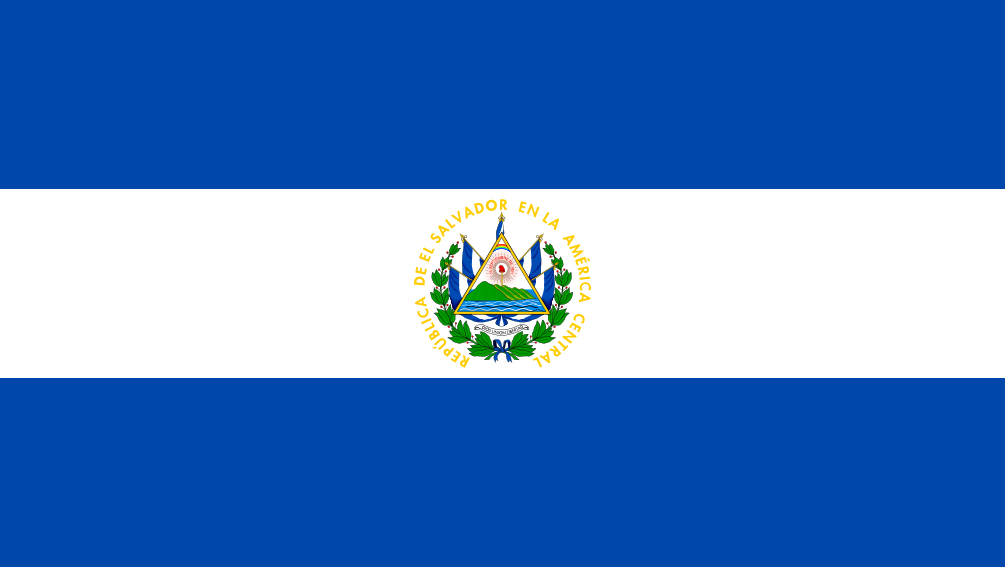
🇸🇻 Country Profile: El Salvador
🌍 Introduction
El Salvador is a Central American country known for its volcanic landscapes, Pacific coastline, and compact geographic size. Located between Guatemala and Honduras along the Pacific Ocean, it is the smallest country in mainland Central America. Its terrain includes volcanic mountain chains, interior valleys, and coastal plains, creating varied natural regions within a short distance.
📌 General Overview
Official Name: Republic of El Salvador.
Capital: San Salvador.
Official Language: Spanish.
Government Type: Presidential republic.
Currency: United States Dollar (USD).
Time Zone: Central Standard Time (CST).
🗺️ Country-Specific Maps
Political maps show departmental boundaries, major cities, and international borders. Administrative maps present departments and municipalities. Physical maps highlight volcanoes, mountain ranges, valleys, and coastal lowlands. Hydrology maps show rivers and watershed systems. Transportation maps display highways, ports, and airport facilities. Thematic maps often include hazard zones, land use, and elevation.
👥 Demography & Population
El Salvador has an estimated population of about 6–7 million people. Major cities include San Salvador, Santa Ana, and San Miguel. A large share of the population lives in urban and peri-urban areas. Settlement patterns are concentrated in central valleys and transport corridors. Population density is relatively high compared to many neighboring countries.
🏛️ Administrative Divisions
El Salvador is divided into departments, which are further subdivided into municipalities and local districts. Departmental capitals function as administrative and service centers. Municipal governments manage local planning and services.
💰 Economy & Industries
The economy is supported by services, manufacturing, trade, and agriculture. Key sectors include textiles, food processing, retail, and logistics. Agricultural products include coffee, sugarcane, and grains. Remittances and small business activity are important contributors.
🌟 Places of Interest & Tourism
Notable places include volcanic national parks, crater lakes, Pacific beaches, and historic towns. Popular destinations include volcano viewpoints, surf beaches, and cultural heritage centers. Nature and coastal tourism are growing sectors.
🚆 Transportation & Connectivity
Transportation is mainly road-based, with highway networks linking major cities and border crossings. The main international airport serves the capital region. Seaports support cargo movement. Rail transport is minimal, with roads carrying most passenger and freight traffic.
🌦️ Climate & Geography
El Salvador has a tropical climate with warm temperatures year-round and distinct wet and dry seasons. Higher elevations are cooler than coastal areas. The landscape is strongly shaped by a chain of volcanoes and uplands, along with coastal plains.
📜 History & Culture
El Salvador has a history rooted in Indigenous civilizations and later colonial development. Cultural traditions include music, crafts, festivals, and regional cuisine. Historic churches and town centers reflect colonial-era architecture and local heritage.
📌 Quick Facts & Trivia
El Salvador is the smallest country in mainland Central America by area. It has numerous volcanoes across its territory. The Pacific coast is known for surf beaches. Coffee has long been an important crop. Most major cities lie along the central volcanic corridor.