
Niger
National Flag of Niger
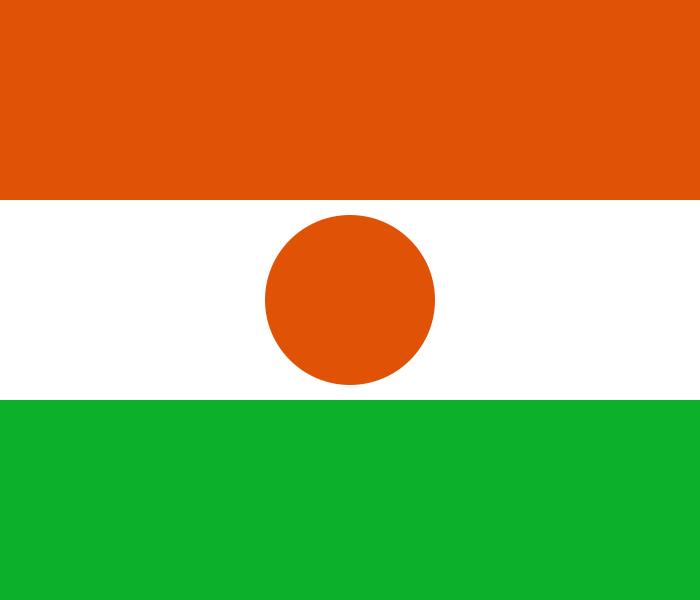
🇳🇪 Country Profile: Niger
🌍 Introduction
Niger is a large landlocked country in West Africa known for its vast desert landscapes, Sahelian plains, and historic caravan routes. Much of its territory lies within the Sahara Desert, with more fertile zones in the south. The Niger River is the country’s main permanent waterway and supports key population centers.
📌 General Overview
Official Name: Republic of the Niger.
Capital: Niamey.
Official Language: French.
Government Type: Republic (under transitional authorities).
Currency: West African CFA Franc (XOF).
Time Zone: West Africa Time (WAT).
🗺️ Country-Specific Maps
Political maps show regional boundaries, major towns, and international borders. Administrative maps present regions and departments. Physical maps highlight the Sahara, Sahel belt, plateaus, and mountain massifs such as the Aïr range. Hydrology maps show the Niger River and seasonal watercourses. Transportation maps display highways and trans-Sahel corridors. Thematic maps often include climate zones, vegetation belts, and resource areas.
👥 Demography & Population
Niger has an estimated population of over 25 million people. Major cities include Niamey, Zinder, and Maradi. Population distribution is concentrated in the southern strip where rainfall supports farming. Northern desert regions are sparsely populated. Many communities live in rural agricultural and pastoral settings.
🏛️ Administrative Divisions
Niger is divided into regions, which are further subdivided into departments and communes. Regional capitals serve as administrative and service centers. Local administrations manage community-level governance.
💰 Economy & Industries
The economy is supported by agriculture, livestock, mining, and trade. Key activities include millet and sorghum farming and livestock herding. Uranium mining is an important export sector. Small-scale trade supports local livelihoods.
🌟 Places of Interest & Tourism
Notable places include desert landscapes, mountain regions, cultural towns, and protected reserves. The Aïr Mountains and desert heritage sites are key attractions. Cultural and desert tourism are main themes.
🚆 Transportation & Connectivity
Transportation is mainly road-based, with highways linking major southern cities and border crossings. Air transport connects key urban centers. There is no extensive national rail network. Long-distance travel often depends on road corridors.
🌦️ Climate & Geography
Niger has a predominantly arid climate with very low rainfall in the north and semi-arid conditions in the south. A short rainy season occurs in southern regions. Temperatures are high for much of the year. Terrain includes deserts, plains, and mountain areas.
📜 History & Culture
Niger has a history shaped by trans-Saharan trade, regional kingdoms, and caravan routes. Cultural traditions include music, crafts, storytelling, and nomadic heritage practices. Multiple ethnic groups contribute to cultural diversity.
📌 Quick Facts & Trivia
Most of Niger lies within the Sahara Desert. The Niger River flows through the southwest of the country. Uranium is a major mineral export. Population is concentrated in the southern Sahel zone. Pastoral and farming livelihoods are both important.
Downloads
Download JSON file Download KML file Download Shapefile Download FlagTopics covered